
TLCS: How to Find a Game When You Don't Know What You're Looking For
We have 1000+ games now in our collection ready for day 1. That's the good news and the bad news.
Choice is an opportunity and a problem. If you walk into the average board game store having played Catan and maybe Ticket to Ride, you look up at the wall of boxes and you have no idea where to start. Everything has a dragon or a spaceship on it. The names mean nothing. Someone behind the counter asks if you need help and you don't even know what question to ask. You end up buying an expansion for something you already own and leaving.
Most game stores organize alphabetically, which doesn’t help, or with a few broad categories like “Family” “Strategy” and “Party.” These are a decent start but these group a game like Azul, which takes 30 mins and anyone can learn, with a game like Twilight Imperium, which takes eight hours and can end friendships.
Online people might use a search engine, but we realized for physical browsing libraries had figured out a great method centuries ago. They created systems where you could wander into a section, find something interesting, and realize there's a whole category of things you never knew existed. So we borrowed that idea.
The Tabletop Library Classification System
TLCS. A system to make sense of the rapidly expanding world of board gaming. Every game in our library gets a number. Ticket to Ride is 470.2. Each part of that number tells you something different about the game. The genre, the mechanics, the complexity, and how it actually feels to sit down and play it.
The Categories: What Kind of Game
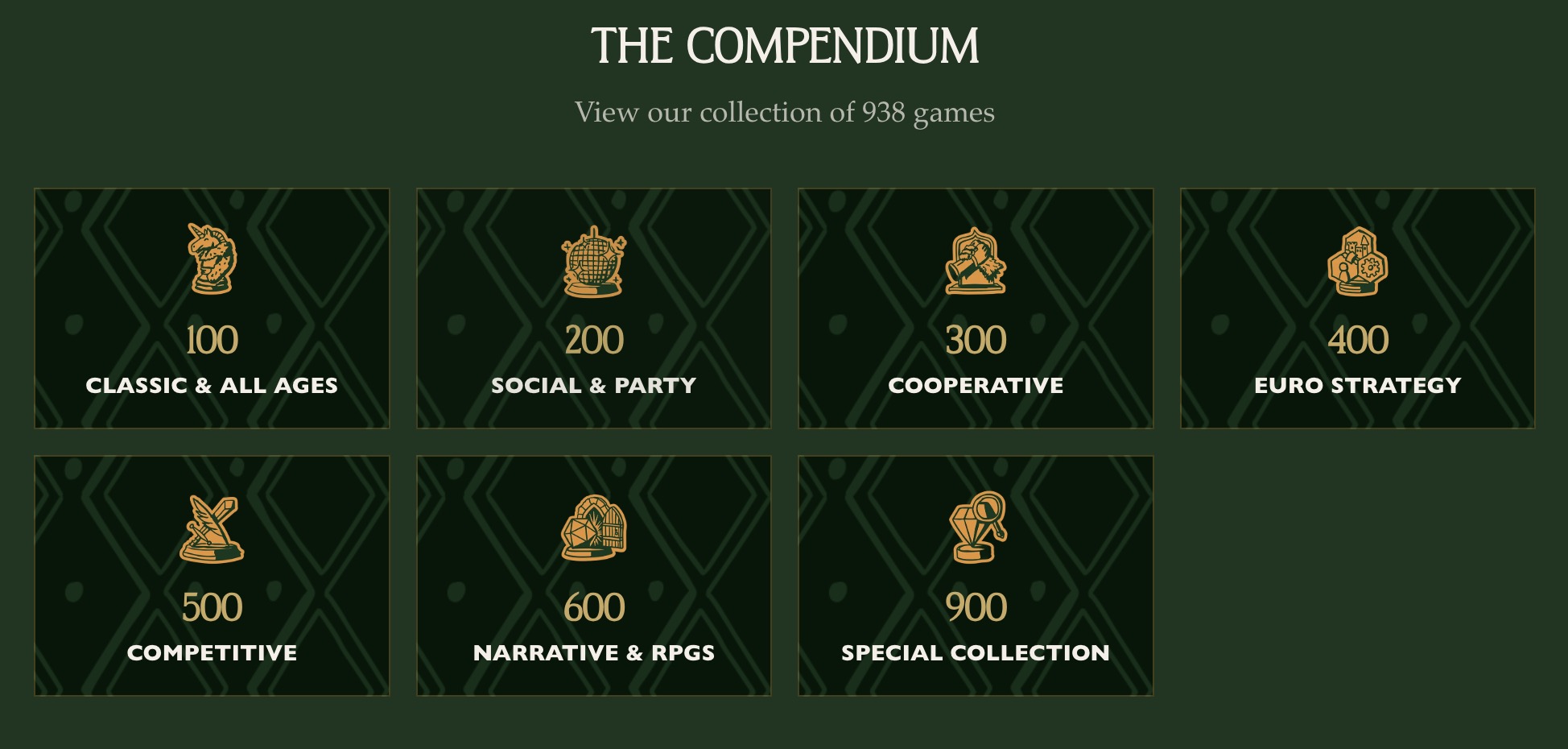
The first digit tells you the broad genre.
But these aren't organized by theme, you won't find a "Fantasy" section or a "Sci-Fi" shelf. Instead, the categories map to the question you're actually trying to answer: What kind of experience am I in the mood for tonight?
Want something where you're all on the same team? That's the 300s. Want to quietly optimize your own little engine while your friend does the same? 400s. Want direct conflict where every move might ruin someone's plans? 500s.
That first step helps us narrow you down from 1000+ games to a couple hundred you can glance at.
100s – Classic & All Ages (Chess, Crokinole, Azul) Something everyone at the table can play. Your parents, your kids, your friend who "doesn't like board games." Simple to learn, still satisfying to master.
200s – Social & Party (Codenames, Mafia, Wavelength) Games for groups. Hidden roles and accusations. Generally, things that are more fun the sillier it gets.
300s – Cooperative (Pandemic, Spirit Island, The Crew) Everyone wins or everyone loses. You're battling the game together, not each other.
400s – Euro Strategy (Wingspan, Agricola, Ticket to Ride) Build your own thing without someone knocking it over. Optimization, resource management, satisfying combos. You're competing, but mostly by being better—not by attacking.
500s – Competitive (Munchkin, Root, Twilight Imperium) Direct conflict, tough choices. Territory control. War games. Two decks dueling. Every action could hurt your opponent as much as it helps you win.
600s – Narrative & RPGs (D&D, Gloomhaven, Sleeping Gods). Experiences over mechanical optimization. Get lost in a story. Campaign games that remember what happened last session. Characters that grow.
900s – Special Collection
Puzzles. Prototypes. Teaching copies.
(The 700s and 800s are currently empty for a little room to grow.)
The Subcategories: How it Works
The second digit tells you how it works—the core mechanic, the thing you're actually doing over and over. The game loop.
Ticket to Ride is in section 470, which is called Networks & Routes. Every game on that shelf shares the same basic engine: you're building connections between places, claiming routes, sometimes blocking paths.
This is the real unlock. A new player doesn't walk in asking for "a network game"—they don't know that's a thing. But after they play Ticket to Ride and love it, they can find it on the shelf and look around. Airlines Europe. Brass: Birmingham. Power Grid. Age of Steam. Same family, different complexity levels and styles.
They've just discovered a genre they didn't know existed. Same way you might realize you're really into noir films after stumbling into one.
Complexity: How Heavy Is It
Then every game gets a decimal from .1 to .5. This tells you how much it's going to ask of you.
- .1 – Light. Codenames, Uno. Teach it in two minutes, play it in fifteen. Your non-gaming friends will be fine.
- .2 – Medium-light. Scrabble, Sky Team, Azul. A little more to chew on, but you can still learn as you go.
- .3 – Medium. Mahjong, Wingspan, Chess. Real decisions, real depth, but won't melt your brain.
- .4 – Medium-heavy. Viticulture, Agricola, Brass. Set aside time with the rulebook, or get a teach. But can really be worth it.
- .5 – Heavy. Lisboa, Spirit Island, Twilight Imperium. Bring snacks. Bring patience. This is an event of interlocking rules and mechanics to test you.
The nice thing about this: say a friend recommends Lisboa (460.5), which is great but also a .5—a genuine commitment. You can walk over to the 460: Worker Placement section, find Lisboa, and then look left. There's Everdell at .3, Stone Age at .3, Fabled Fruit at .2. Same family of games, easier entry points. Start there, work your way up. It's a path, not a cliff.
The Gameplay Taxonomy: How it Feels
Those four numbers tell you what category a game belongs to and how complex it is. But some games in the same category can still feel completely different to play.
So we added one final layer—five dimensions that describe the how the game feels to play. You can find these by looking up the game on our website, and they describe five essential axis to how a game feels.
Theme: Abstract → Themed → Immersive
Is the game purely abstract like backgammon, or is there a world to get lost in?
Randomness: Luck-ish → Tactical → Skill
Is playing about rolling dice and hoping, or is every outcome a result of your decisions?
Interaction: Minimal → Indirect → Direct
Are you basically playing solitaire next to someone, or stealing their stuff and ruining their plans?
Learning: Intuitive → Moderate → Heavy
Can you pick this up as you go, or do you need someone to teach you first?
Tempo: Light → Thoughtful → Intense
Quick and breezy turns, or deep tension between every move?
These are meant to add texture to the classification. Two games might both be worker placement, but if you're tired late in the evening and someone hands you something marked Tempo: Intense, you might want to steer them toward something else.
Where this is headed
Here's the scenario we're building toward. First, even if you don’t know a single game, you can start in a section based on how you want to play and feel confident in a good choice. Second, once you’ve found a game you like, you can explore that subcategory and maybe find a new favorite.
And lastly, our long term goal is some future date where we have a real sense of the kind of games you enjoy. We would love to get to a point where you can come in with a friend, a spouse, and maybe another member you've never met. Four people, four experience levels, probably a dozen different preferences.
If we know what games you've each played and what you liked about them, we can look at your profiles and say: here are three games none of you have tried that you'll probably all enjoy.
That's the difference between "we have 800 games" and "here's a game for you."