
Game of the Month: Foundations of Rome
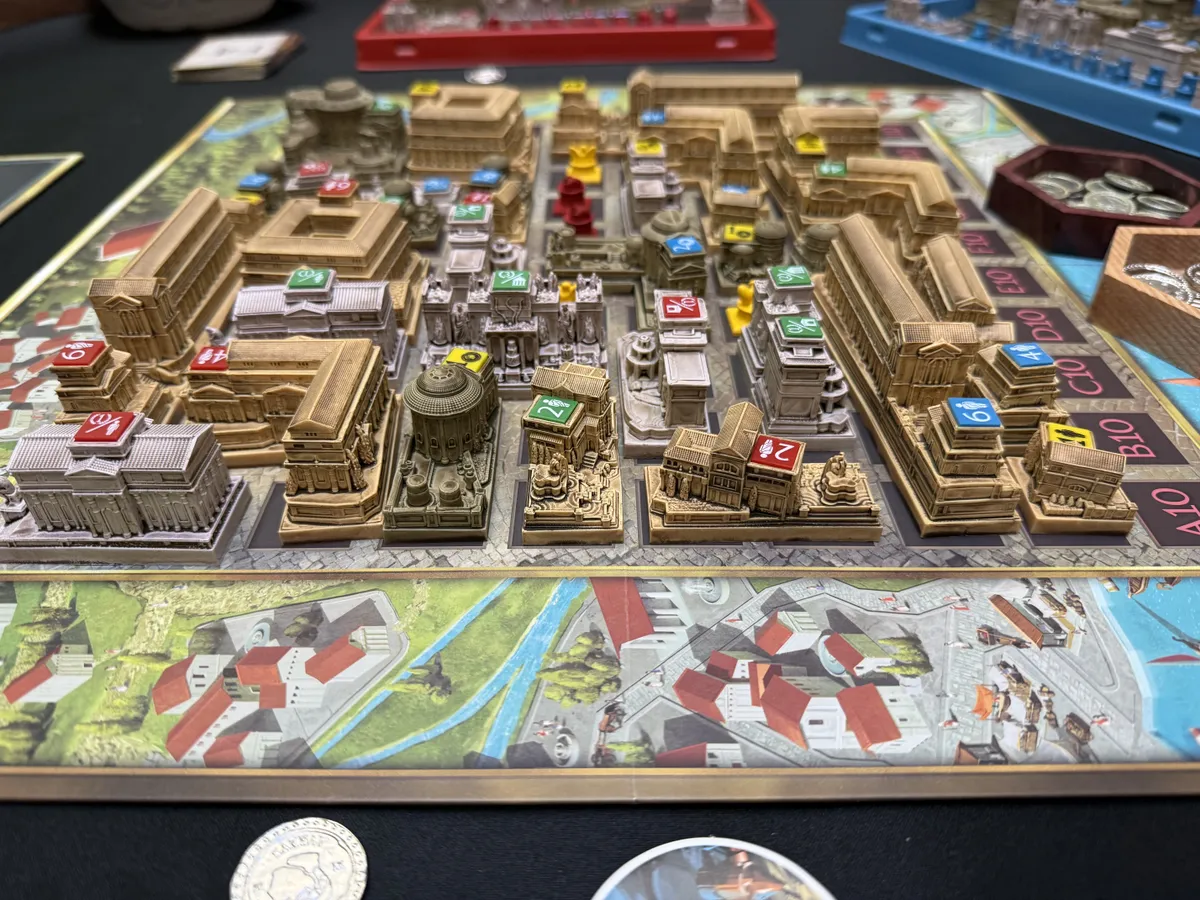
Emerson Matsuuchi's Foundations of Rome and table presence for the rest of us
In the lobby at Tabletop Library there's a first edition of Acquire, from 1964: a flat board, a bag of plastic tiles, paper money. It's one of the best games ever designed, but on a table it has the meek presence of Monopoly if reworked by an accountant.
Other games, though, stop you in your tracks. You see a massive table covered in spaceships as players are three hours into playing Twilight Imperium. The table with the huge plastic aliens is playing Nemesis, and they spent the last hour just learning the game. A collection of cozy wooden animals and eggs in Wonderous Creatures hides a deceptively crunchy game. For most, an awesome looking table often means you have to have set aside your day to play.
That split, between games that look incredible and games easy to get into, comes mostly from Kickstarter. Crowdfunding gave board games designers something most art forms never get: a working middle class, where one or two people with a good idea can catch a break and make a decent living. But a Kickstarter is judged on a picture. Nobody can play a game before backing it, so a clever card game that looks like a pile of cards doesn't sell, and a sculpted dragon makes you look. This was supercharged when 2020 sent everyone home, and tabletop campaigns raised a record $236.6 million adding bling to everything. Because Kickstarter feeds an enthusiast community, this step up in design often went along with a heavy book of rules.
Foundations of Rome is our pick for November because it took all that bling and spent it on a game a first-timer can play.
Arcane Wonders funded it just before the lockdowns, raising more than $1 million from over 8,000 backers. Our copy, the Emperor Edition, is a box you carry with both arms. But inside is a game about as light as Ticket to Ride. Board Game Quest summed it up: "The production values are off the charts... And the gameplay is very accessible. Buy a lot, place polyomino-shaped buildings, collect points and money."
The family tree runs back to that first edition on our shelf. Damion Schubert of Zen of Design called Rome "a quick and breezy game reminiscent of a deeper Acquire but with a final game result that looks like a beautiful model of a bustling roman city." Houses bring population, shops bring money, and civic buildings score for everything around them, including what your rivals built. So the game is about neighbors: whose block you crowd, which lot you grab before someone makes it valuable, when to knock down your own small building for a bigger one. "It is easy to learn and play," Alex of Talking Shelf Space wrote, "but the overbuilding rules make this a knife fight in a phone booth."
And here the gorgeous buildings do real work. A cardboard orc and a plastic orc do the same job. In Rome, the buildings' size and shape are information: you can see where the money is and whose block is getting crowded without reading a single track. The designer, Emerson Matsuuchi, made his name on Century: Spice Road (2017), a card game so spare it's mostly trading little colored cubes. The restraint here is in the design, because the presentation is anything but restrained.
The quibbles are real. Every building has to go back in the box which can be a pain, and it fits a big box that barely fits a shelf. Plus, $310 for the deluxe edition is a lot even for this board game. Reviewer Cheddarface's verdict: "While I wouldn't probably say it's worth the massive expense, Foundations of Rome is undoubtedly a marvel to behold... and I think a perfect introduction to the hobby for someone who doesn't play much other than Ticket to Ride."
That's the whole argument for a library. The expense is ours. The city is yours for an evening.